
I’m a Principal Research Fellow in corpus linguistics at University College London (UCL), focusing on research methodology, computing and statistics.
I’ve been a UCU branch officer at UCL for the best part of two decades. I was a local negotiator for the UCU branch in the Pay Framework negotiation of 2004-5, and have been variously, the branch secretary, vice president or president ever since. I have a lot of experience negotiating on behalf of members locally, as well as representing them in personal disputes, advising and supporting other reps.
I realise that by standing for Vice President (the Vice President becomes President for a year), I will have to give up branch leadership responsibilities for a bit! But I think it is healthy if I step aside and give others a chance. I trust my colleagues realise I won’t abandon them!
I am also the regional secretary for London, which is primarily about ensuring that the Region functions democratically and takes initiatives – like organising Central London demonstrations – that a single branch cannot do by itself.
I am a national negotiator for UCU elected by Sector Conference. I have been re-elected several times and have considerable experience in dealing with quite difficult negotiations. I have always argued that the first responsibility of a negotiator is to be accountable to the members they are negotiating for. But I have also asked colleagues to commit to the kind of action that will be required to win.
I am a founding member of UCU Left, the left coalition of activists and reps which was formed in 2006 from the Natfhe Rank and File and AUT University Worker groups when the union merged.
How my academic work affects my perspective
My academic background is in Artificial Intelligence (AI) and machine learning. I was working in an AI research group in Nottingham in the 1990s, long before AI became fashionable. After I moved to UCL, one of the key pieces of software I developed, called ICECUP, had an AI algorithm, termed a theorem prover, at its core.
Over the years, I have written and employed a variety of AI algorithms to solve complex problems. Whereas a theorem prover is mechanistic (if complex), other classes of algorithm, including machine learning and ‘fitting’, are by definition heuristic, and heavily laden with assumptions. They don’t try to solve a problem by trying everything. They guess where to look. So the assumptions can be wrong, the guesses can be wrong and the problem can be formulated incorrectly. The algorithm can simply be looking in the wrong place.
Anyone who has worked in this area is aware of the paradox of apparent success. The more plausible the output, the more users begin to believe the algorithm is giving them (it ‘knows’) the right answer.
I have long been concerned at the common, albeit naive, tendency to treat results of algorithmic guesswork as if it were actual defensible ‘knowledge’. I wrote a stochastic parser that appeared very impressive – until colleagues rightly critiqued the output. And, after completing an ESRC project on knowledge discovery in corpus linguistics, I became greatly concerned at an enthusiastic anonymous reviewer who wrote that they looked forward to the day they did not need to think about research design and statistics.
Making the contrary argument means work. It means resisting the temptation to treat science as a mere procedure and the substitution of critical scientists by computerised black boxes as inevitable. But this is intellectual work generations of researchers have been trained to do.
I have made a small beginning in my area. In statistics, I have written a blog and a book on understanding how statistical reasoning works from first principles. But as I write elsewhere on this blog, the task we face is much greater.
Organising in defence of HE
It is very hard to stand up for yourself, never mind your science, when you don’t know whether you will have a job next year. I spent 26 years on serial fixed-term contracts of various kinds, six in Nottingham and 20 at UCL, before my post was finally underwritten by the university in 2015.

I have fought for the rights of research staff all of my working life. For example, on the right you can see a poster and leaflet I wrote back in 2006 when the Fixed Term Employee Regulations’ 4-year rule came into force.
Organising research staff is difficult. Even though legally contracts of employment and the research contract between funder and employer are quite different, staff are often treated as if the end of a research grant inevitably means redundancy for the employee. Hyper-exploitation, IP theft and even harassment of researchers (especially where researchers are women) are not uncommon. Even when we win things it can feel like we take two steps forward and one step back all the time.
So we have to seize every opportunity to organise collectively, such as when the law changed in 2002-6 and during Covid lockdown. The new Employment Rights Act may offer new opportunities.
But we can also organise researchers as part of a bigger fight, one in which we can advocate over the conditions in which we work in government. The fate of research staff, and the conditions in which we work, is ultimately tied to that of the university system itself.
I have also spent my working life defending Higher Education and scientific research. I see science as a collective socially-accountable enterprise, and education as the birth-right of everyone in society. I believe it is extremely important for researchers to stand up for science against those – like Farage and Trump – who would wish to trash it. Or, indeed, those in Government who treat Higher Education as a mere commodity.
In 2002, I worked with professorial colleagues at UCL to stop the ill-conceived merger between UCL and Imperial College London. The ‘Campaign for UCL’, as the UCL end of the campaign was called, stopped the merger (which would have been catastrophic) but it also encouraged colleagues to start treating the university’s Academic Board more seriously. While management licked their wounds, my colleagues, union members prepared the ground for democratic renewal.

Ten years later, and shortly after the £9,000 tuition fees were introduced, the Provost of UCL decided he wanted to ‘reform’ (in reality, abolish) the university’s academic statute, Statute 18. Colleagues rightly sensed that this was a prelude for redundancies, and a campaign was born. Although the academic statute did not protect all staff (research staff like me were excluded, as were staff with teaching fellow contracts and academic-related staff), we argued it was in the interests of all staff to defend it.
The local UCU branch was in the driving seat of this campaign. We made the case for extending the statute to all staff engaged in academic work while refusing to accept the removal of protections the university management wanted. Mobilising on Academic Board carried an overwhelming argument in opposition to these changes and the Provost and the governing body (Council) backed down.
I was the convenor of the Second and Third Conventions for Higher Education in 2016, organising against what was then called the HE Bill, later the Higher Education and Research Act 2017. You can read more about this campaign here. Notably the previous campaigns helped build this one.
These were campaigns about defending the idea of a University. They are important to learn from because they illustrate the type of approach that UCU will need to build a side to defend Education. We need mass participation to defend HE, not the ‘two delegate per union branch’ approach that has unfortunately characterised recent UCU-organised lobbies. We have to stop fighting for our sector with both hands tied behind our back!
We were then plunged into the USS dispute of 2018. Although this is often thought of in UCU circles as a ‘trades dispute’, in fact it was intensely ideological. Winning the argument that the deficit was an artefact of the valuation methodology – an argument that is common sense today – took time and patience. But it was central to the eventual victory of that campaign.
That campaign had a number of other lessons, including the importance of democratic control over disputes. When you are on strike and losing money by the day, you need to know that those who are representing you are doing their best to use your sacrifice to win the best that can be achieved.
I don’t have space here to talk about the many campaigns I have been involved in since over the years, but I will try to post some reflections on this website.

Building capacity to fight
Many of the time the challenge is to convert what appears to be an ideological or ‘political’ dispute into an industrial one. This is something of an obsession of mine.
Many activists recognise this problem: we defeat senior management in public, at Academic Boards/Senates and staff meetings, but they veto staff decisions and plough on regardless. Once senior management have committed to a course of action, it will take a major mobilisation to shift them. So we have to build campaigning capacity, and that can help us build industrial capacity.
This is a problem common across all sectors. But it is particularly acute in Higher Education. University employers are becoming shameless. The last two years of redundancy programmes show that they are worrying less about their reputations and more about what they think they can get away with. With government ministers ignoring the fate of colleges and universities, and letting college principals and VCs run amok, the burning question for UCU is how can we turn this around?
One of the most widespread, extreme and public examples of what I am talking about occurred during the Marking and Assessment Boycott (MAB) of 2023. In university after university, Vice Chancellors ‘did a Ratner’. But whereas in 1991, Gerald Ratner famously trashed his own brand by an off-the-cuff remark, in 2023, UCEA did it by encouraging VCs to railroad Exam Boards, justifying this by the alleged ‘harm’ to students of the MAB. (A discredited degree was apparently not ‘harm’.) An important exception was Cambridge, where, by mobilising staff, the union branch was able to use the academic governance regime to prevent this.
UCEA’s gamble followed the infamous Queen Mary marking-by-bot scandal of 2022. If QM’s reputation survived such public traducing, surely other universities could follow suit? (By the way, such issues are not just damaging to university reputations. They threaten the legal right to award degrees, which depends on the existence of independent academic oversight by a community of academics, known as ‘condition B4’.)
I have long advocated the idea of an action committee. We set up our first one in UCL in the late 1990s (at my prompting) to campaign against the then-Provost’s ‘Core Activities Agenda’ (sic), and it is a model that we have repeated multiple times.
An action committee is a very simple idea. It is a union campaign group open to ordinary members to join (excepting management), which has one aim: to conduct a campaign within the college or university. The action committee helps draft the petition, posters and leaflets, produces material for the website, and crucially, reaches out to colleagues and students and persuades them to take a stand. Cambridge UCU adopted the same approach in their 2023 campaign.
Petitions should always include a ‘would you like to join the action committee?’ tickbox. This means that the petition is directed both to management and is used as a tool to build the campaign.
This approach means that the action committee will rapidly become a broader and more open group than the pool of existing union reps or the branch committee. Many members are highly motivated by the specifics of a particular campaign, but don’t wish to take on broader union work. Members of the branch committee should join in, but they should facilitate rather than dominate it.
During the course of the campaign, important strategic and tactical questions will arise. Regular action committee meetings means that the group takes ownership of these questions. Certain decisions, such as recommendations to ballot for strike action, will require a vote at a full members’ meeting to agree. But many decisions can be made by the committee itself.
The action committee is not a substitute for other bodies, but it can take on a task of organising members, challenging the management narrative and readying members to fight. This means that when a ballot of members begins, the campaign to win hearts and minds is already well underway.
Once industrial action is called, the action committee should become a strike committee. A strike committee should meet frequently (ideally, daily) during the strike. It organises the strike itself, and provides a space for reps and picketers to share information about the experience of the picket line.
At UCL we have very many entrances, which we tend to picket all morning. A lunchtime strike committee meeting is the place where members know they can come to discuss how the strike has been going. Instead of being spread out in relatively small numbers, they can come together and make collective decisions.
Importantly, negotiators should be summoned to the meeting: members want to know how the dispute is progressing and what future action might produce. In 2018, this proved crucial when our branch strike committee got wind of a potential sell-out and called a lobby of UCU headquarters the following day.

Finally, the strike/action committee brings members forward who may be interested in becoming a department rep. Many members get a taste for union organising, and see that they can make a difference by increasing the involvement. This often happens at the end of the action, but of course there is no impediment to recruiting reps during the campaign. If the action committee is limited to existing reps this option doesn’t exist.
By the way, this approach is a far cry from those in the union, including Jo Grady, who talk about ‘building capacity’ as if it were a long-term approach separate from organising industrial action. The most obvious problem with that approach is that it condemns the union to defeat in the short-to-medium term. But defeat is often unnecessary. Moreover, we have to learn to stretch our organising muscles and our industrial ones!
Demonstrations
Over the years, as HE secretary for London Region and then regional secretary, I have organised demonstrations for London Region, including those during the various waves of strikes we have had since 2018. If you have seen video or photographs of large UCU demonstrations in London, I probably organised the march. We ask all branches to provide stewards, so we can ensure that the demonstration goes off safely.
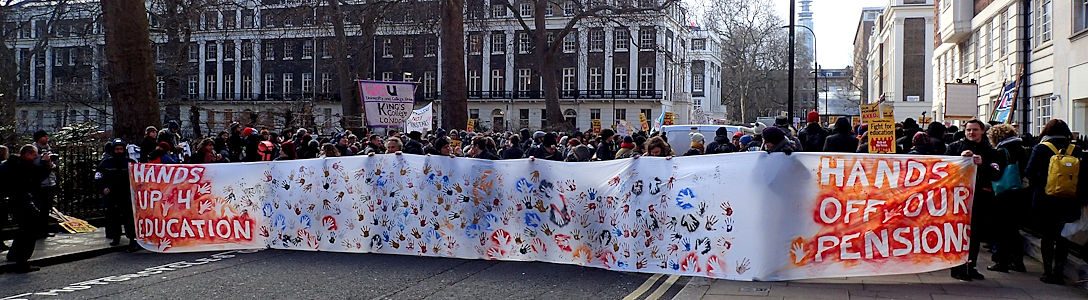
When in 2022, UCU called a national demonstration from Euston but then failed to organise a route, I took on the task, and – fortuitously, since UCEA moved the location to Friends House on Euston Road at the last minute – we led the demonstration past the very offices where UCU and UCEA were meeting for negotiations (see the image at the top of the site). Our negotiators on the inside were very amused!
Demonstrations like this build collective confidence. Members who may otherwise be scattered over picket lines all day, or might otherwise stay at home, participate with colleagues and discover new affinities. Participants can clearly see who is on our side, who is passive and may need persuading, and who, occasionally, is against us.
Some people find crowds difficult for a number of reasons. But all too often, we feel isolated, especially since Covid lockdown has changed working patterns. But even relatively small demonstrations can remind you that you are not alone.
In November 2010, my colleagues in the English Department at UCL joined the NUS demonstration against the £9,000 tuition fee hike.
As they gathered, in the midst of large numbers of their own students, they began to realise that as many as half the staff in the department had turned up.
We are not alone. If we fight for what we all believe in, for education and for science, we can win.
See also
- My UCL home page
- My statistics blog, corp.ling.stats
- UCU Left website
- Follow me on Bluesky, or if you are still there, X(twitter)